

Blog
Authorized vs Replica Rolex: Ethics, Cost and Risk
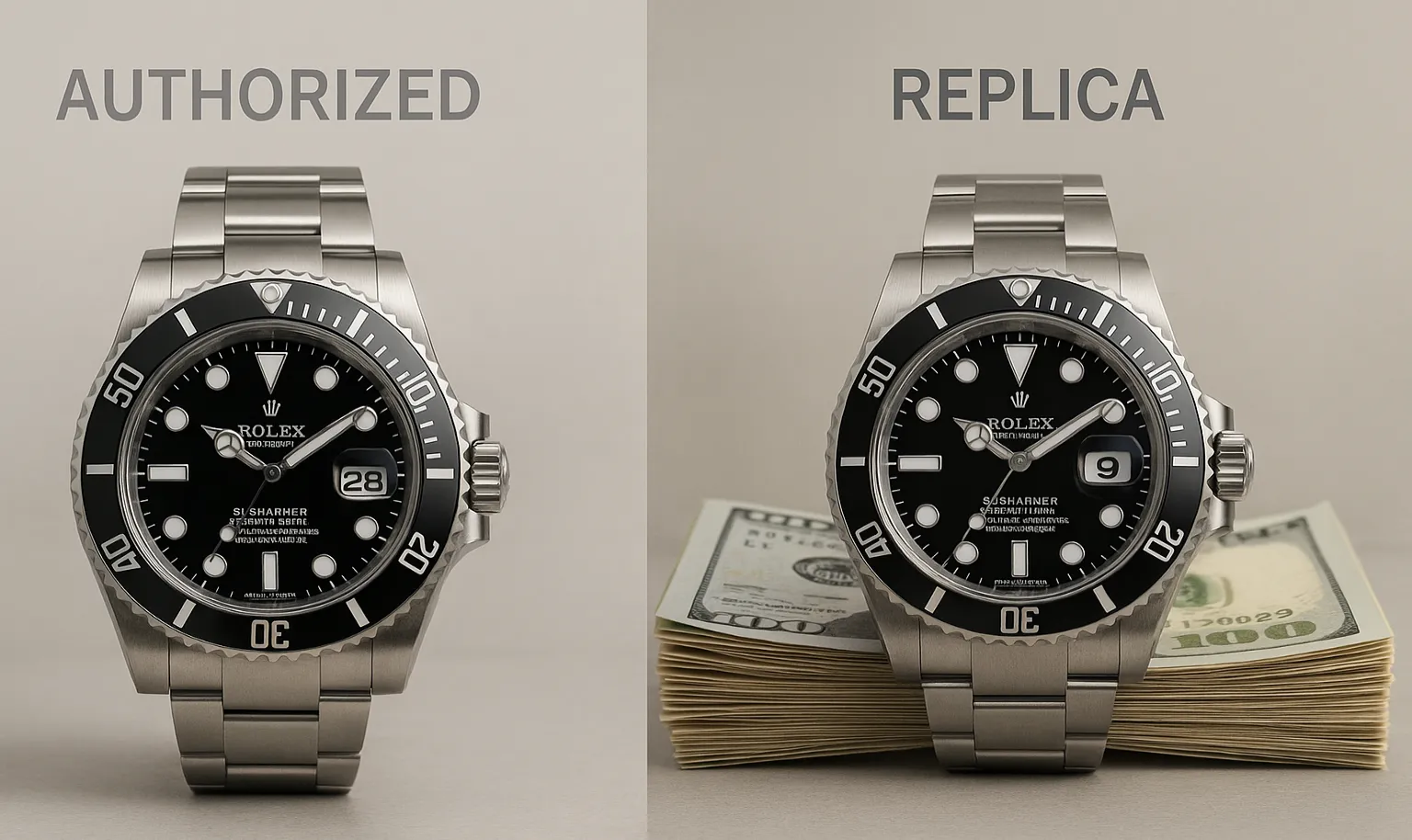
A genuine Rolex can cost twenty times what a good replica costs, and both will tell the time to within a few seconds a day. That ratio is the whole argument in miniature, and it is worth taking apart piece by piece: what “Swiss Made” really means, what the brand premium buys, and what the risks of ownership actually are.
The case for a high-quality replica is stronger than most people assume, though it rests on specific facts rather than slogans. Here is the evidence on both sides.
What “Swiss Made” actually requires
Most buyers assume the label means a watch was almost entirely built in Switzerland. The rule is narrower: at least 60% of the finished watch’s value must be generated there, and that calculation can include research, development and even domestic marketing costs. When you count physical components rather than francs, the Swiss share can fall as low as 20% once dials, cases and Asia-sourced bracelets are tallied.
That is a legal definition, not a moral one, and it cuts both ways. If a case made abroad can be counted as Swiss after a Swiss balance wheel and some allocated engineering salaries are added, then a buyer who prefers to purchase the same steel shell closer to its source is not committing fraud. They are reading the statute more literally than the marketing does.
The scarcity machine
Modern luxury marketing owes a great deal to Rolex. Its mystique was assembled over decades through protected names and dial colours plus a dealer network on tight allocations, producing a product that stays permanently just out of reach. The brand is adding capacity, but the new site in Bulle will not open until 2029, so waiting lists remain the norm for now.
None of that is illegal. It is, however, a supply strategy, and it means part of what a buyer pays for is the fact that other people cannot easily get one. Whether that counts as a fair reward for innovation or as rent-seeking is the ethical question underneath the whole debate.
The investment argument does not hold
The strongest justification for buying genuine is resale, and the numbers have not cooperated lately. WatchCharts data shows the average Rolex shedding 9.8% of its value across two years. Even with a 17.6% gain across five years, propped up by the pandemic luxury boom, the return trails shares, property and even bonds.
Run the comparison directly:
- Genuine at $20,000 — worth about $23,520 after five years, a 17.6% gain
- Replica plus government bonds — $1,000 watch and $19,000 at 3% yields roughly $23,026, a 15.1% gain with less volatility
- Replica plus an S&P 500 ETF — about $31,450 at a 10% annualised return, a 57% gain
The broader trend is not helpful either. Rolex prices slipped 2.1% across the last nine quarters and fell 5.7% year on year in 2024 as the post-Covid bubble deflated. “Investment watch” often turns out to be a polite way of saying status signal, and the replica buyer keeps the capital free to compound elsewhere.
Theft, damage and running costs
A $20,000 watch on a wrist is a target. London has logged 43,000 watch thefts since 2018 on its own, and some of those robberies turned violent. Carrying a genuine piece can put the owner and bystanders at risk in a way a replica rarely does.
Damage is the quieter problem. An authorised service runs roughly $800 to $1,500 and requires original parts, while a third-party repair on a replica costs $50 to $200. Insurance adds 1% to 2% of the declared value every year, plus serial verification and paperwork. For someone who simply enjoys the design, the replica removes most of that exposure.
Status, self-worth and the psychology of criticism
Luxury marketing sells more than objects; it sells a feeling of achievement. The feeling does not survive scrutiny. A $20,000 watch and a $1,000 replica leave your bank balance in very different places, and only one of those differences is on your wrist.
Criticism of replicas often comes from somewhere other than principle. For many owners, a genuine Rolex functions as a badge, and a convincing copy threatens the exclusivity that badge depends on. Belittling replica wearers protects the value of an expensive purchase, which is a human reaction rather than an ethical position.
There is an environmental angle too. Precious-metal mining and energy-heavy manufacturing carry a real footprint, and simpler materials reduce it. The replica trade also employs people in regions where watchmaking jobs are scarce, which is a genuine benefit even if it sits awkwardly beside the intellectual-property question.
What the law says
Ownership of a replica is legal in most jurisdictions. Making or selling a watch that carries a protected trademark is not, which places most of the activity in civil rather than criminal territory, closer to sampling in music than to counterfeiting currency.
Critics say that erodes creative incentive. Supporters point out that Rolex’s twenty-year patent on the Oyster case expired in 1946, and that the company still litigates to protect designs from that era. Where protection stops being a shield for invention and becomes a permanent toll is a fair question, and one the courts keep answering differently.
Weighing it up
If original craftsmanship, Swiss tradition and legal clarity matter most to you, the authorised watch is the right purchase. If you believe a design belongs to culture after a reasonable period, that conspicuous consumption should not endanger anyone, and that capital ought to work harder than 17.6% in five years, a high-quality replica is a defensible choice, provided you accept the legal grey area.
Either way, the decision is about values rather than value. Our about page explains how we source and grade what we sell, and the FAQ covers the practical questions buyers ask most.
Frequently asked questions
Is buying a replica Rolex illegal?
In most countries, owning one is legal. Producing or selling goods that carry a protected trademark is the part that breaks the law, which is why the trade sits in a civil grey zone rather than being treated as a criminal offence for the buyer.
Do genuine Rolexes hold their value?
Less reliably than the marketing suggests. The average Rolex lost 9.8% over two years according to WatchCharts, and prices fell 5.7% year on year in 2024. A 17.6% five-year gain still trails equities and property.
How much cheaper is servicing a replica?
Substantially. An authorised Rolex service costs roughly $800 to $1,500 with original parts, while an independent watchmaker will typically charge $50 to $200 for work on a replica movement.
Jake Ehrlich
Jake Ehrlich is a renowned Rolex historian, collector, and the Editor & Publisher of Jake's Rolex World, one of the most widely read Rolex publications globally. With a passion that spans decades, Jake has owned and worn over 650 Rolex watches, ranging from rare…
All articles by Jake Ehrlich →