

Blog
Rolex Buyer FAQ: Your Comprehensive Guide to Rolex Watches

Most first-time buyers arrive with the same handful of questions, and the answers rarely come in one place. This guide collects them: where Rolex came from, how the catalogue is organised, what separates a genuine watch from a high-grade replica, and how to buy without paying for someone else’s mistakes.
How Rolex became Rolex
Hans Wilsdorf and Alfred Davis started the company in London in 1905 under the name Wilsdorf & Davis. Wilsdorf picked the word Rolex in 1908 because it was short, easy to pronounce in any language, and supposedly echoed the idea of horological excellence. The firm moved to Geneva in 1919 and has been Swiss ever since.
The technical record is a list of firsts. The Oyster case of 1926 produced the first genuinely waterproof wristwatch, the Perpetual mechanism of 1931 made self-winding practical, and the Datejust of 1945 put an automatically changing date in a window at three o’clock. The crown emblem appeared in the 1920s and has stayed essentially unchanged.
That history is why the brand carries weight beyond its price. Hillary wore an Explorer to the Everest summit in 1953, a Deep Sea Special went to the bottom of the Mariana Trench in 1960, and James Cameron took a Deepsea down in 2012. Sponsorship money follows the same logic: Wimbledon and the other majors in tennis, the Masters and Ryder Cup in golf, Formula 1 and Le Mans in motorsport, the Sydney Hobart in sailing, and the Grand Slam of Show Jumping.
The catalogue, sorted by purpose
Every collection answers a different question, which is why the lineup looks so broad at first glance.
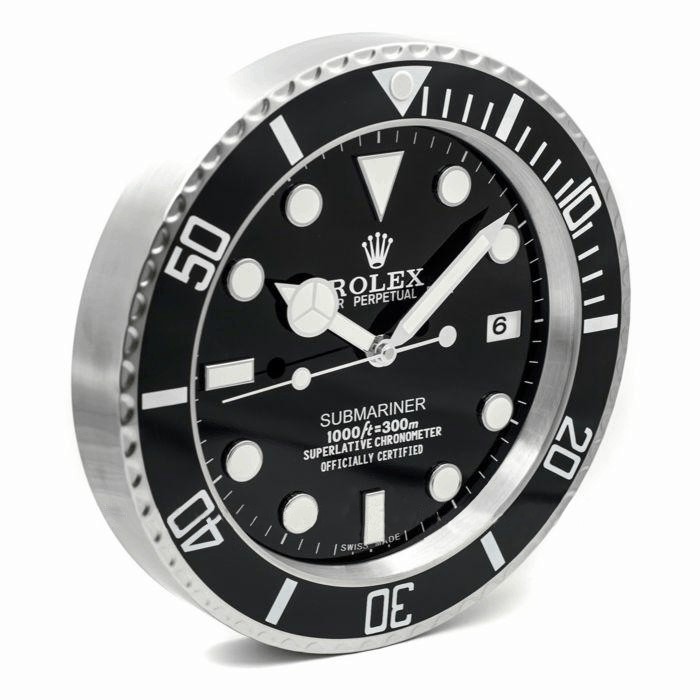
- Submariner — the dive watch, water-resistant to 300 metres and the most copied design in the world.
- Daytona — the chronograph, built around motor racing and the hardest steel watch to buy at retail.
- Datejust — the dress watch with a date, in continuous production since 1945 and still the volume seller.
- GMT-Master II — two time zones on one dial, made for pilots and frequent travellers.
- Explorer — the mountain watch, plain dial, no ceremony.
- Yacht-Master — the nautical line, softer and more decorative than a Submariner.
- Oyster Perpetual — time only, no date, the cleanest entry into the brand.
- Land-Dweller — the newest collection, designed for daily wear on dry land.

What actually separates a genuine from a super clone
A Submariner super clone is not the market-stall fake of twenty years ago. The better examples use 904L stainless steel, sapphire crystal and automatic movements, and they reach roughly 98% visual and tactile similarity to the real thing. That is close enough that a stranger across a table will not tell.
The gap shows up elsewhere. A genuine watch brings a five-year international warranty, factory service for life, and a resale market that treats it as an asset. A replica brings none of those, and it cannot be sold as anything other than what it is. Ownership for personal use is generally lawful in most countries; selling a replica, or passing one off as genuine, is where the legal trouble starts.
There are practical trade-offs too. Replicas cost a fraction of retail and let you wear a valuable-looking watch without the anxiety, but repairs are harder to arrange and often not worth the expense. For collectors who want variety without tying up capital, that is a fair exchange. For anyone buying as an investment, it is not.

Buying without getting burned
Authorised dealers are the safest route and the slowest. You get a new watch, full paperwork and a warranty, and you pay list price with no discount. Resellers and auction houses move faster and can beat retail on pre-owned pieces, but the burden of verification shifts to you, so check the seller’s customer reviews before any money moves.
Start with the serial, engraved between the lugs at six o’clock, and match it against the paperwork and the production year. Check the dial printing under magnification, confirm the cyclops magnifies by 2.5 times, listen for a smooth sweep rather than a tick, and weigh the watch — 904L steel is heavier than it looks. Box, papers and a documented service history all add value, and their absence should be reflected in the price. If a watch is offered far below market, assume it is either stolen, assembled from parts, or not what it claims to be.
Living with the watch
Rolex recommends service every five to seven years, and the work is best done by a certified watchmaker who will replace seals and check the movement rather than polish away its edges. Between services, keep the watch away from strong magnets, sustained heat and hard impacts, rinse it with fresh water after salt exposure, and store it in a dry box rather than a sunny windowsill.
Insurance is worth the premium on anything valuable. A rider on a home policy usually costs one to two percent of the watch’s value each year, which is cheap next to replacing a Submariner out of pocket.

What the market does, and does not, promise
Rolex holds value better than almost any other consumer object, and rare references can do far more than hold. A Daytona bought in the 1960s for $200 can bring six figures at auction; Paul Newman’s own watch fetched $17.8 million. Discontinuation adds a premium too — the green Submariner 116610LV jumped after it was dropped in 2020.
None of that is a guarantee. Prices for ordinary steel sports models have softened since 2022, and a watch bought at a heavy premium over retail can take years to break even. Buy the watch you want to wear, and treat any appreciation as a bonus rather than a plan.
Frequently asked questions
Can you legally own a replica?
In most countries, yes, as long as it is for personal use and you never present it as genuine or try to sell it. Selling replicas is a different matter and can bring fines or legal action depending on where you are.
How often should a Rolex be serviced?
Every five to seven years for normal wear. A watch that has sat unused for a decade should be checked sooner, since lubricants dry out even when the movement is not running.
Do Rolex watches make good investments?
Some do, particularly rare and discontinued references. Most do not beat a diversified portfolio, and returns are never guaranteed. Think of the purchase as a pleasure first and a store of value second.
Jake Ehrlich
Jake Ehrlich is a renowned Rolex historian, collector, and the Editor & Publisher of Jake's Rolex World, one of the most widely read Rolex publications globally. With a passion that spans decades, Jake has owned and worn over 650 Rolex watches, ranging from rare…
All articles by Jake Ehrlich →