

Blog
Rolex Imperfections: Why Even Rolex Makes Mistakes

Collectors like to say a perfect Rolex is a story and an imperfect one is a fact. The brand has built a century of identity around precision, yet the watches fetching the highest auction prices are almost never flawless. The flaw is frequently the reason anyone cares.
The twenty-million-dollar mistake
October 2017 is where this story starts. Phillips, in New York, auctioned a stainless Rolex Daytona and the price reached $17,752,500 — a record for any wristwatch at auction at the time. The seller was James Cox, who had received it from Paul Newman decades earlier. The buyer has never been named.
What gets lost is that Rolex saw nothing special in the watch when it left Geneva around 1968. Reference 6239 carried an “exotic” dial — blocky indexes, a contrasting outer track around the edge, and art deco subdials — that the factory treated as a slow seller. Dealers struggled to move them, some were swapped for standard dials at service, and production stayed tiny until it quietly ended. That unwanted configuration is now the most valuable in the brand’s history.
Perfection is a story, not a specification
Rolex publishes a standard of -2/+2 seconds per day after casing, against the -4/+6 COSC baseline an ordinary Swiss chronometer must meet. Behind it sits enormous volume: Morgan Stanley and LuxeConsult put 2024 output near 1.18 million watches and revenue above CHF 10.5 billion, roughly a third of the Swiss market by value, with more than 800,000 certificates issued annually.
Run the arithmetic. A 99.5% first-pass rate across 1.18 million watches leaves about 5,900 pieces a year with some cosmetic or functional variance. At a fantasy 99.9%, more than a thousand still ship with something off. Nobody builds flaws on purpose; these are hand-assembled objects made from batches that vary like all materials do.
Where the flaws actually enter
Assembly is the point where dozens of separately made components meet: dial, hands, lume plots, bezel, crystal, chapter ring, bracelet and case. Every line runs its own tolerance stack, and the final mating is manual.
- Dial printing. A pad fractionally off-register shifts the text, ink batches drift in color, and lacquer cures unevenly. Meters First Subs, gilt Explorers and red-text Double Reds all began as ordinary output.
- Bezel seating. An insert glued into its ring can sit slightly off, with a pearl a touch off-center or a click stop half a millimeter from true north.
- Lume. Chromalight paste varies in thickness and hue, while vintage radium and tritium aged into cream, coffee and pumpkin.
- Hands and dial seating. A hand set a hair low sweeps the chapter ring; a dial half a degree off tilts the date under the cyclops.
- Finishing and bracelets. Brushed lugs and polished flanks are hand-finished, and solid end links bolted to cases with their own micro-variance produce the notorious SEL gap.
Grails born from factory errors
The vintage market names its mistakes, part of why they cost so much. In 2013, Hodinkee recorded a standard ref. 6239 at about $28,750 against $93,750 for a Paul Newman example in similar condition — three times the money for identical mechanics.

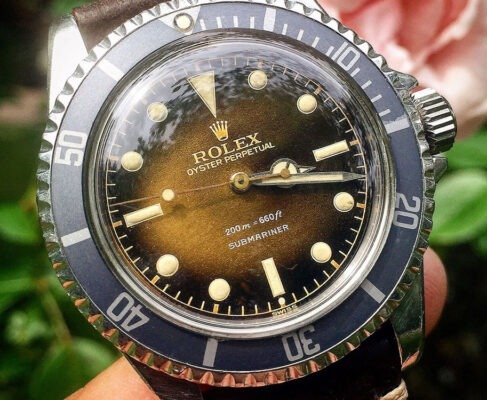
Tropical dials are black dials faded brown by decades of UV, heat and humidity. Even, chocolate-toned fading commands a premium; blotchy fading destroys value. The look cannot be ordered or convincingly faked, and no two examples match.
The 1954 GMT-Master ref. 6542, built for Pan Am crews, shipped with a translucent bakelite bezel and radium numerals. It cracked in ordinary cockpit conditions and carried enough radium that Rolex swapped survivors to metal inserts from the late 1950s; originals now rank among the most wanted vintage pieces. Early Sea-Dwellers printed two red lines on the ref. 1665 in a separate pass later dropped. Ref. 5512 and 5513 Submariners listed depth metric-first before flipping to imperial — identical watches trading at different prices. Gilt Explorer dials, gold text on black lacquer, predate matte dials and age into spidering and patina.
Modern imperfections still shipping
None of this ended with the vintage era. Chromalight, introduced around 2008, can leave hands and hour plots glowing slightly different blues. The cyclops is glued at final assembly and may sit a hair left, right or low. Rehaut engraving and the laser-etched crown can drift a fraction of a degree, enough that some buyers reject a watch at delivery.
Solid end links rarely sit perfectly flush, bracelet pins wear with use, and clean rooms cannot rule out dust beneath the crystal. Forum threads fill with owners who found a microscopic fiber on a new dial. Rolex catches the obvious misses; the tiny ones still ship.
Forgive, fix, or send it back
Look for honest ageing: even tropical fade, settled patina, a bracelet stretched in proportion to its years. Forgive whatever needs magnification — a slightly offset cyclops, one lume plot a shade off, an SEL gap of a few tenths of a millimeter. Send back anything functional or visible at arm’s length: a bezel that will not hold, a date that misses the window, dust you can spot unaided, a bracelet that rattles.
That line is thin, which is why the same checklist keeps reappearing. Our guide to spotting a fake Rolex runs the tells authenticators use, and the buyer FAQ covers what to do when a watch arrives with a question mark attached. A Daytona with a crooked subdial is a different problem from one whose pushers do not work.
Go back to that 1968 chronograph once more. It departed Geneva as an unpopular dial variant on a model dealers had written off, then sold in 2017 for a sum that would buy a Manhattan penthouse. The imperfection was not the opposite of value; it was the source of it.
Frequently asked questions
Are Rolex imperfections common?
Yes, if you accept that any hand-finished mechanical watch carries small deviations. Output runs above a million pieces a year at very tight limits, yet owners regularly document lume color drift, cyclops offset, rehaut misalignment and uneven SEL fit. The majority stay within what Rolex considers acceptable.
What is a tropical dial?
A black Rolex dial that decades of sunlight, heat and humidity have turned brown. Even, attractive fading is prized because it is unrepeatable and impossible to fake convincingly, which makes every tropical dial a one-of-a-kind aging artifact.
Is a small flaw grounds for returning a new Rolex?
It depends. Variances visible only under magnification are normal for hand-finished watches. Functional problems, defects visible at arm’s length, water-resistance concerns or anything affecting timekeeping belong back with the dealer under warranty.

Jake Ehrlich
Jake Ehrlich is a renowned Rolex historian, collector, and the Editor & Publisher of Jake's Rolex World, one of the most widely read Rolex publications globally. With a passion that spans decades, Jake has owned and worn over 650 Rolex watches, ranging from rare…
All articles by Jake Ehrlich →