

Blog
Journal
Rolex Reference Number Guide: Understand Every Code
 4 min read
A Rolex reference number looks like noise until you learn the pattern. Once you do, a string such as 126710BLRO tells you the family, the bezel, the metal and the colour without a single word of description.
Rolex has never published an official decoder. The system below comes from decades of collector observation, and it holds for the overwhelming majority of modern references.

From four digits to six
Early references were short. The GMT-Master 1675, a favourite among vintage collectors, used only four digits, and five-digit codes appeared around the middle of the twentieth century.
Six-digit references became standard in the early 2000s. Today most modern models combine those six digits with suffix letters that specify bezel colour or insert material.
Take 126710BLRO. It identifies the current GMT-Master II with a red and blue Cerachrom bezel, a black dial and, typically, a Jubilee bracelet.
The model family codes
Most references begin with a 1 or a 2. That leading digit often reflects a generation or update cycle, though Rolex applies the rule loosely, and lines such as the Sky-Dweller and Pearlmaster follow their own logic.
The next three digits are more dependable. They point to the core family.
- 124: Explorer
- 126 and 116: Datejust, across several sizes
- 140: Submariner without a date, on older or specific references
- 166: Submariner Date from the five-digit era
- 168: Submariner Date in precious metals
- 165: Explorer II or Daytona, depending on the prefix
- 167: GMT-Master and GMT-Master II
- 214: Milgauss
- 226: Sea-Dweller and Deepsea
- 326: Sky-Dweller
The overlap at 165 is the one that trips people up. Explorer II references usually start with 2, as in 216570, while Daytonas start with 1, as in 116500 or the current 126500. The prefix settles it.
The fifth digit tells you about the bezel
On a six-digit reference, the fifth digit usually describes the bezel. Dress models are less consistent, but tool watches follow these conventions closely.
- 0: smooth or domed
- 1: rotating, as on dive or GMT models
- 2: engraved
- 3: fluted, common on the Datejust
- 4: gem-set or bark finish
- 6: rotating, in an alternative or updated form
The last digit is the metal
The final digit before any letters tells you what the case and bracelet are made of.
- 0: stainless steel, which Rolex calls Oystersteel
- 1: Everose Rolesor, steel with Everose gold
- 2: Rolesium, steel with platinum
- 3: yellow Rolesor, steel with yellow gold
- 4: white Rolesor, steel with white gold
- 5: solid Everose gold
- 6: platinum
- 8: solid yellow gold
- 9: solid white gold
Why the letters are French
Rolex is based in Geneva, where French is the official language, so the suffixes are French abbreviations. A small vocabulary covers most of them.
Bleu is blue. Noir means black, rouge red, vert green, jaune yellow and chocolat brown. Lunette is bezel, and glace is crystal.
- BLRO: bleu and rouge, the blue and red “Pepsi” bezel
- BLNR: bleu and noir, the blue and black “Batman” bezel
- CHNR: chocolat and noir, the brown and black “Root Beer” bezel
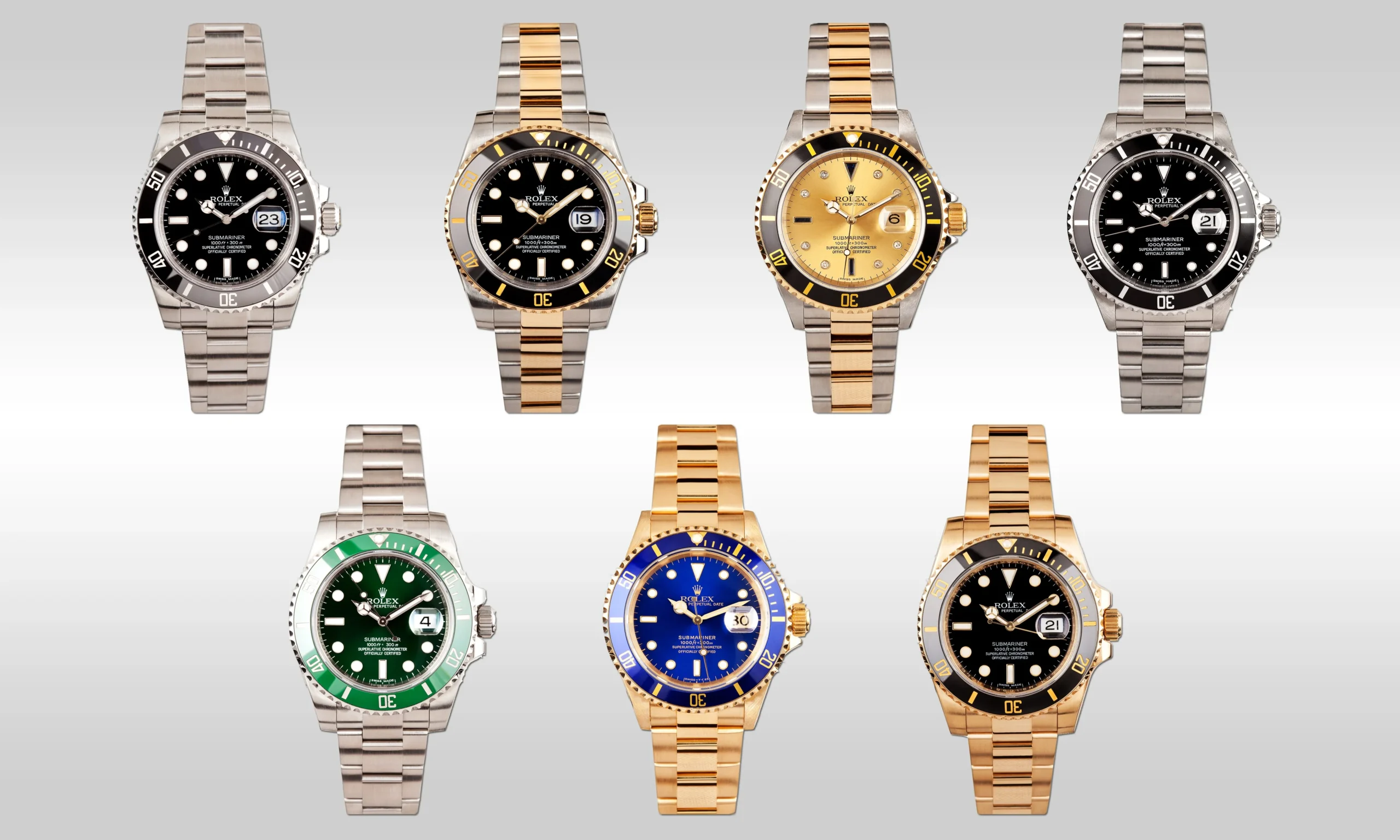
- LN: lunette noir, a black bezel, as on the Submariner 126610LN
- LV: lunette verte, a green bezel, as on the “Starbucks” 126610LV
- LB: lunette bleu, a blue bezel, as on the 126619LB
- GV: glace verte, a green sapphire crystal, as on the Milgauss 116400GV
Gem-set suffixes
Jewelled references add longer combinations, most often on limited Day-Dates, Pearlmasters and Daytonas. They are rarer, but useful when searching pre-owned listings.
- TBR: tessellate brillants, or diamond-set
- TEM: tessellate émeraude, or emerald-set
- SABR: saphirs and brillants, sapphires with diamonds
- SANR: saphirs noir, black sapphires
- SARU: saphirs and rubis, sapphires with rubies
Putting it together
Decoding a reference becomes second nature once you have used the system a few times. Take 126610LN: 1266 identifies the Submariner Date family, the 1 means a rotating bezel, the 0 means stainless steel, and LN confirms a black bezel.
The same logic applies whether you are looking at a steel sports watch, a vintage four-digit piece or a gem-set Day-Date. Start with the family, read the bezel and metal digits, then translate the suffix.
That fluency helps with authenticity checks and price comparisons, and it lets you talk to dealers on equal terms. If you want to put the codes to use, browse the Submariner replica range and match each reference to its specification, or work through the frequently asked questions for buying advice.
Frequently asked questions
Why did Rolex move from four-digit to six-digit references?
The longer format carries more information. Four digits were standard for much of the twentieth century, five appeared mid-century, and six became normal from the early 2000s as bezel, material and generation details needed their own places.
What does the LN suffix mean on a Submariner?
LN stands for lunette noir, French for black bezel. On the 126610LN it indicates the black Cerachrom ceramic insert used on one of the most common steel configurations.
Are all Rolex suffix letters French?
Yes. Colours, components and gem terms all come from French, which is why a basic grasp of words such as bleu, noir, lunette and glace makes almost every reference readable.

Jake Ehrlich
Jake Ehrlich is a renowned Rolex historian, collector, and the Editor & Publisher of Jake's Rolex World, one of the most widely read Rolex publications globally. With a passion that spans decades, Jake has owned and worn over 650 Rolex watches, ranging…
All articles by Jake Ehrlich →