

Blog
The Fascinating Evolution of Rolex Watch Designs

A Rolex from 2026 still carries visible traces of a watch built a hundred years ago. The same case logic, the same legible dials and the same insistence that a timepiece survive whatever the wearer does to it are all still there. That continuity did not happen by accident. Each generation solved a specific problem, and the solutions accumulated into what we now recognize as the brand’s design language.
A London workshop with one obsession
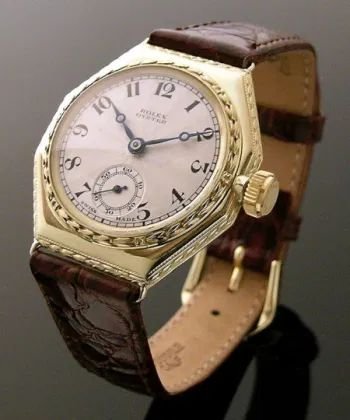
In 1905, when pocket watches still dominated, Hans Wilsdorf set up shop in London with a clear idea: wristwatches could be reliable instruments rather than jewellery for women. He was German by birth, and his movements came from Aegler, a Swiss supplier, because he cared more about accuracy than about making every component himself.

The strategy paid off in 1910, when a Rolex became the first wristwatch to hold the Swiss Certificate of Chronometric Precision, awarded by the Official Watch Rating Centre in Bienne. That certificate did more than advertise accuracy. It repositioned the wristwatch as equipment for professionals, and the designs that followed were built around that claim.
The Oyster case rewrote the rules
Dust, damp and water were the enemies of every early wristwatch. The Oyster case of 1926 answered all three with a hermetically sealed construction: screw-down caseback, screw-down bezel and a winding crown that threaded into the case. The name came from the way an oyster shell closes, and the effect was a watch that could be worn without concern.

Rolex then proved the point in public. In 1927, Mercedes Gleitze, a young swimmer, crossed the English Channel wearing an Oyster, spending more than ten hours in cold water. When she finished, the watch was still running. That stunt turned a technical claim into a story the public could repeat.

Divers, dates and a president
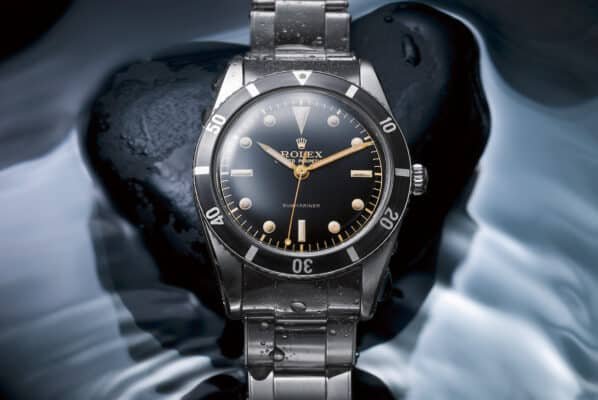
The Submariner of 1953 took the sealed case underwater on purpose, rated to 100 metres when most watches were not rated at all. Later versions doubled that to 200 and then 300 metres. A rotating bezel let a diver track bottom time and decompression stops, and luminescent markers kept the dial readable in murk. James Bond and Steve McQueen wore the model on screen, and a tool became a style object.
Dress watches changed in parallel. The Datejust of 1945 was the first self-winding chronometer to show the date through an aperture at 3 o’clock, and the Cyclops magnifier arrived in 1953. Eleven years after the Datejust, the Day-Date went further and spelled out the weekday in full, a first for a wristwatch. It was offered only in gold or platinum, which is why it became associated with heads of state and earned the nickname President.

Altitude and time zones
The Explorer, launched in 1953, honoured the first successful ascent of Everest by Edmund Hillary and Tenzing Norgay. The watch worn on that climb was an Oyster Perpetual rather than the Explorer itself, but the model was designed as a tribute to the expedition: simple dial, strong case, luminous markers, nothing that could fail at altitude.
Two years later came the GMT-Master, developed with Pan American Airways for crews crossing multiple time zones. A rotating 24-hour bezel and an additional hour hand let a pilot read home time and local time at once. The two-colour bezel that made the model famous was a practical device for separating day from night, not decoration.

Speed, yachting and the modern icons
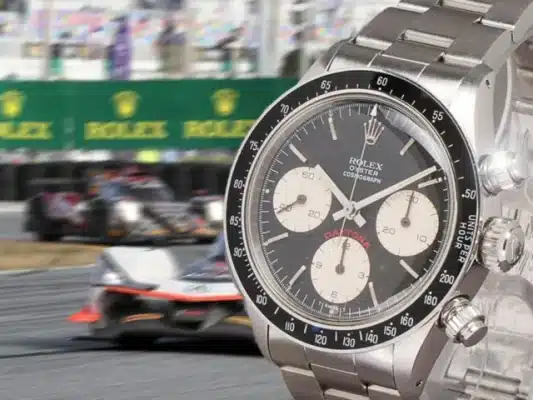
Motorsport entered the catalog in 1963 with the Cosmograph Daytona, built for racing drivers. Its chronograph paired with a tachymeter scale that could measure speed up to 400 kilometres or miles per hour, and the name tied it to the Daytona International Speedway in Florida. Paul Newman’s association with the model later turned a racing tool into an auction legend.
Rolex moved into yachting in 1992 with the Yacht-Master. Unlike the Submariner, it was never intended as a working dive instrument. The bidirectional bezel with raised polished numerals, the precious-metal options and the softer silhouette made it a luxury object for people who spent their weekends on the water rather than under it.

Sport, celebrity and the deep
The brand’s cultural reach widened through sport. Golf partnerships began in the 1960s with Arnold Palmer, Jack Nicklaus and Gary Player, while tennis brought Wimbledon, the Australian Open and players such as Roger Federer and Chris Evert into the same orbit. These deals did not change the watches, but they changed who wanted one.
Exploration went the other way, downward. In the 1960s a Rolex Deepsea Special was fixed to the bathyscaphe Trieste for its descent to the deepest point of the Mariana Trench. Decades later the Oyster Perpetual Deepsea marked James Cameron’s solo dive to the same place. Marine conservation followed, with support for coral reef work and shark research.

What the replica world inherited
Every design decision described above is now a reference point for replica makers. Four things in particular are measurable and therefore copyable:
- The geometry of the Oyster case and its seals.
- The proportions of a Maxi dial and its markers.
- The taper and link count of a Jubilee bracelet.
- The magnification of a Cyclops lens.
All of them are easy to measure. Early replicas got the outline right and little else. Modern super clones work from the same visual archive and the same material palette, which is why the gap at arm’s length has narrowed so much.
That inheritance is the reason a replica can feel like a piece of the brand’s history rather than a generic watch. If you want to see how closely the current generation follows the originals, start with our super clone collection, or compare specific references in the Submariner range.
Frequently asked questions
When did the Submariner first appear?
1953. The original was rated to 100 metres, a figure that later rose to 200 and then 300 metres as the design was refined.
Which came first, the Datejust or the Day-Date?
The Datejust arrived in 1945 to mark the company’s 40th anniversary. The Day-Date followed in 1956 and added the weekday spelled out in full at the top of the dial.
Did the Explorer go to the top of Everest?
Not literally. Hillary and Norgay wore Oyster Perpetuals on the 1953 expedition, and the Explorer was launched the same year as a tribute to that achievement rather than as the watch on their wrists.

Jake Ehrlich
Jake Ehrlich is a renowned Rolex historian, collector, and the Editor & Publisher of Jake's Rolex World, one of the most widely read Rolex publications globally. With a passion that spans decades, Jake has owned and worn over 650 Rolex watches, ranging from rare…
All articles by Jake Ehrlich →