

Blog
Journal
Which Rolex Is Right for You? A Buyer’s Guide
 5 min read
Picking a Rolex is rarely a pure specification exercise. The watch on your wrist mirrors how you spend your days, what you wear, and the impression you want to leave behind.
The catalogue feels overwhelming at first: dozens of references, several case sizes and prices running from roughly $6,000 to past $50,000. Start with the character of each collection, then narrow by wrist size, profession, occasion and budget.
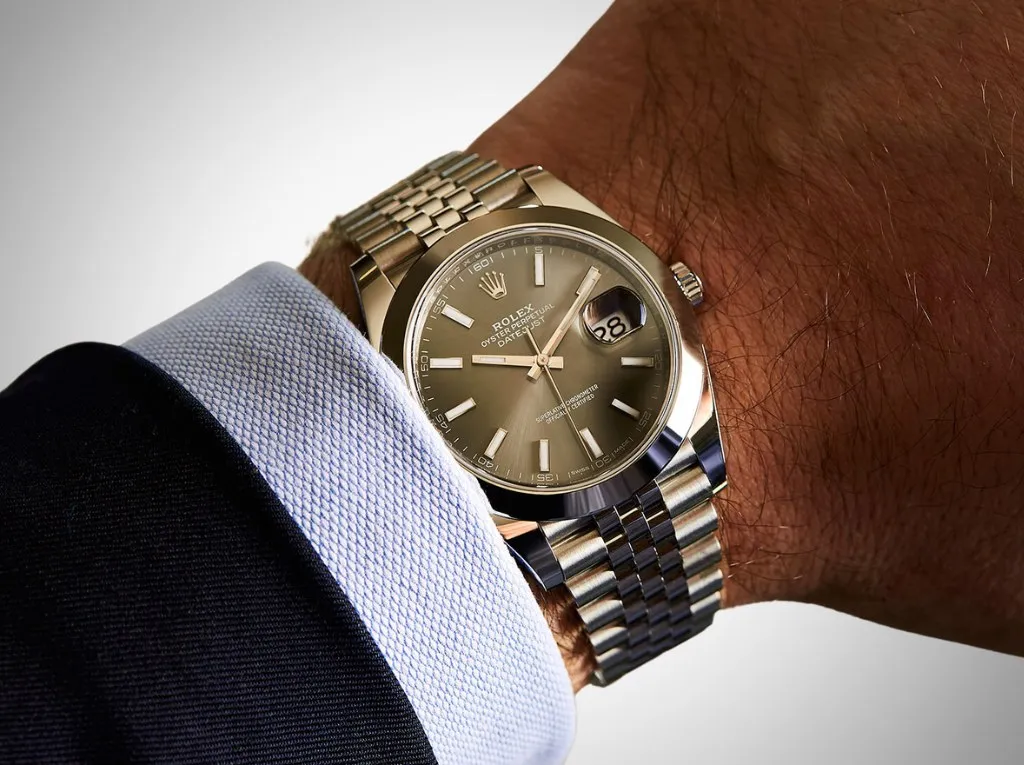
The three classics: Datejust, Day-Date and Oyster Perpetual
These are the quiet members of the family. They favour proportion and finish over spectacle, which is exactly why they age so well.
The White Rolesor Datejust 36, reference 126234, with its fluted bezel costs about $8,350 and may be the most adaptable watch Rolex builds. It works under a shirt cuff and with jeans alike.
The Day-Date 40 ref. 228238 is different territory. In 18k yellow gold it begins above $38,000, and it has been presidential wristwear since Eisenhower received an early prototype in 1956.
Tool watches built for a job
The Explorer, Submariner and GMT-Master II were designed to survive specific conditions rather than sit in a safe. That purpose still shows in every detail.
The Explorer ref. 124270 retails at $7,400. Its 36mm case carries real expedition history, since Sir Edmund Hillary took a 6034 prototype to the summit of Everest.
The Submariner ref. 126610LN, at approximately $9,550, has set the dive-watch benchmark since 1953. It is rated to 300 metres and runs Rolex’s Calibre 3230.

The GMT-Master II ref. 126710BLRO was developed with Pan Am Airways for its pilots in the 1950s, and its dual-timezone layout still earns its place. Colour does the talking: the red-and-blue Pepsi on Jubilee is the extrovert, the blue-and-black Batman ref. 126710BLNR on Oyster is its quieter sibling, and the brown-and-gold Root Beer ref. 126711CHNR carries 1970s cool.
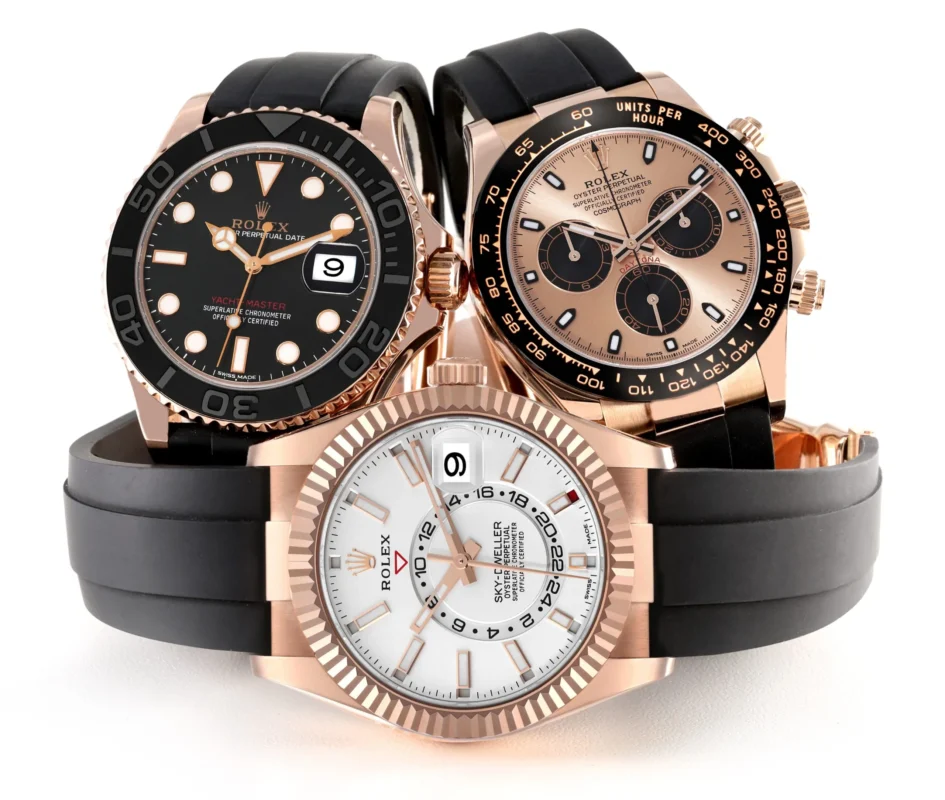
Statement pieces: Daytona, Yacht-Master and Sky-Dweller
Some references are built to be noticed. They carry more metal, more complication or more colour, and they ask for confidence on the wrist.
The Daytona ref. 126500LN lists near $15,100 in steel yet trades between $28,000 and $32,000 secondhand. Paul Newman’s ref. 6239 hammered at $17.8 million at Phillips in 2017, then a record for a wristwatch at auction.
The white gold Yacht-Master 42 (ref. 226659) carries a nautical attitude for about $31,000, while the Sky-Dweller ref. 326939, with its annual calendar and second timezone, starts near $15,800.
Case size and the wrist in front of you
Rolex does not follow a single sizing rule, and the number on the spec sheet matters less than proportion.
Between 26mm and 34mm you are in discreet territory, anchored by the 28mm Lady-Datejust and the Oyster Perpetual 31. The 36mm to 40mm band is the broadest sweet spot, covering the Datejust 36, Explorer 36 and the 41mm Submariner. Above that sit the Sky-Dweller 42, the Yacht-Master 42 and the Sea-Dweller 43.
A 36mm case reads as perfectly proportioned on a 7-inch wrist; the same wrist in a 41mm can look fashionable rather than timeless.
Matching the watch to work and wardrobe
Your daily environment shapes which references make sense. A hospital, a courtroom and a cockpit each reward different qualities.
- Medical professionals: the no-date Submariner ref. 124060 at about $8,550 is legible at a glance and unbothered by constant hand-washing.
- Lawyers and finance: the Datejust 36 in White Rolesor signals competence without shouting.
- Executives: the Day-Date 40 in yellow gold is the traditional answer, while a steel Daytona appeals to leaders who prefer mechanical precision to old-money display.
- Pilots: the GMT-Master II Pepsi was made for the job, and the independent hour hand still earns its place.
- Athletes: the Everose Daytona ref. 126515LN on an Oysterflex strap moves from warm-up to dinner.
- Creatives: the Milgauss ref. 116400GV, with its green sapphire crystal, remains the anti-mainstream choice.
Occasion matters too. A Day-Date ref. 128238 in yellow gold is the definitive black-tie piece, while office days call for the Datejust 41 ref. 126300 or the Oyster Perpetual 41 ref. 124300. The Explorer suits weekends, the Submariner covers sport, and the Sky-Dweller is built for three-continent schedules.
The price ladder, from first purchase to grail
- Under $7,500: the Oyster Perpetual 36 ref. 126000 at about $6,350 is the most accessible new Rolex, and the Explorer at $7,400 adds sports heritage.
- $7,500 to $15,000: the Submariner Date at $9,550, the GMT-Master II from $10,800, the Datejust 41 from $8,150 and the Air-King ref. 126900 at $7,800 form the core.
- Above $15,000: the steel Daytona at $15,100, the Day-Date 40 above $38,000 and the white gold Sky-Dweller beyond $42,000.
Here is the detail worth remembering: the Oyster Perpetual at $6,350 shares the Calibre 3230 and its 70-hour power reserve with the $9,550 Submariner. Past a certain point you pay for the bezel, the water resistance and the mythology, not a different level of engineering.
Where a high-quality replica fits
Not every enthusiast wants to tie up five figures in one accessory. A well-chosen super clone delivers the same silhouette, weight and wrist presence for a fraction of the outlay, which is why many buyers treat one as a sensible first step. Browse the Rolex replica collection or read verified customer reviews before deciding.
Frequently asked questions
Which Rolex works best as an everyday watch?
The Oyster Perpetual 36 or 41. There is no date to reset, water resistance is rated to 100 metres, and the clean dial suits everything from a suit to a t-shirt. If a sports watch appeals more, the Submariner ref. 126610LN is equally versatile and much tougher.
What is the best first Rolex?
The Explorer ref. 124270 at $7,400 is widely treated as the ideal entry point, with real sports-model history and a robust movement at the bottom of the professional range. The Oyster Perpetual 36 saves roughly another $1,000 while delivering the same core experience.
Should I choose a Submariner or a GMT-Master II?
Follow your lifestyle. Swimmers and divers get more from the Submariner’s 300-metre rating and unidirectional bezel. Frequent travellers will use the GMT-Master II’s second-timezone display far more often, and they get the Pepsi, Batman or Root Beer bezel choice.

Jake Ehrlich
Jake Ehrlich is a renowned Rolex historian, collector, and the Editor & Publisher of Jake's Rolex World, one of the most widely read Rolex publications globally. With a passion that spans decades, Jake has owned and worn over 650 Rolex watches, ranging…
All articles by Jake Ehrlich →