

Blog
Journal
Who Cares I’m Already Late: The Rolex Meme Explained
 5 min read
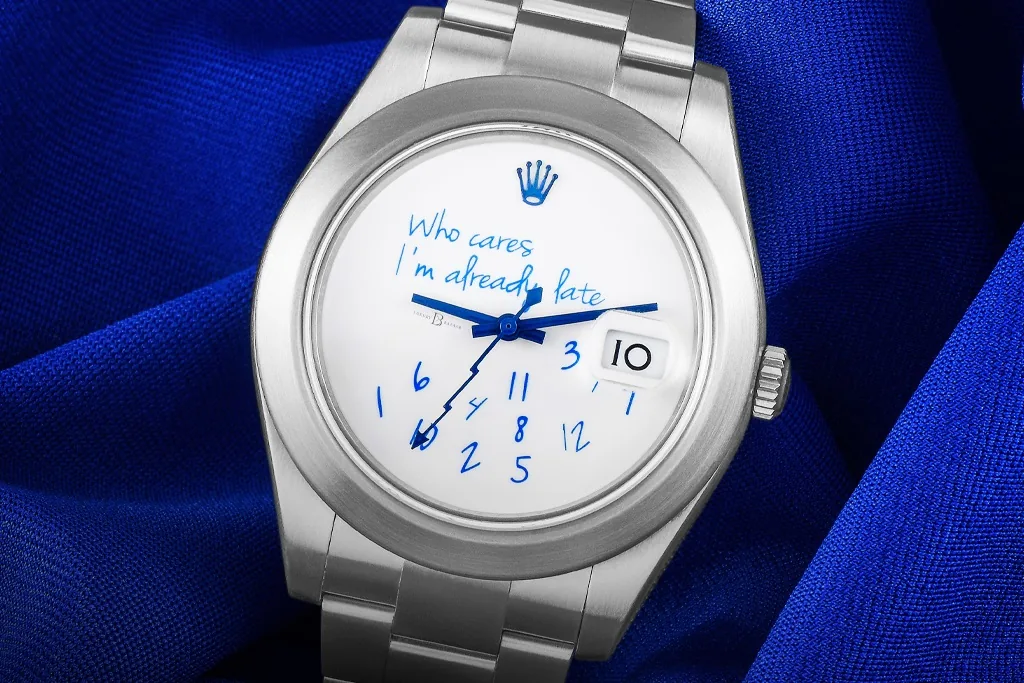
A Rolex dial that reads “Who cares I’m already late” in blue handwriting, surrounded by numerals that have given up on being a circle. It is the funniest thing ever printed where the crown usually sits, and it started as five watches made for one Paris shop.
Here is where the dial came from, what the originals and the modern copies sell for, and the only realistic way to wear the joke without spending five figures on a watch nobody will service.
The 2016 original: Colette meets MAD Paris
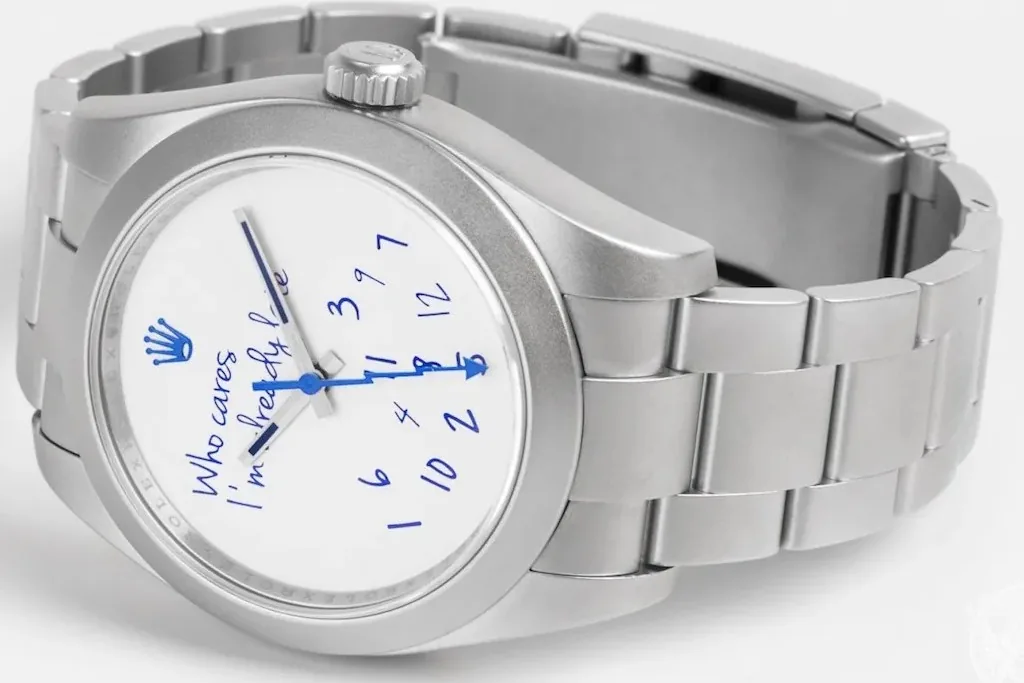
In 2016 the Paris concept store Colette joined forces with MAD Paris, a customiser known for blacked-out rebuilds of luxury watches. They took a Rolex Milgauss and replaced the dial entirely. The sentence ran across the top in Colette blue, the twelve numerals were scattered into the lower half as if dropped, and the hands and crown were finished in the same blue.
Because the Milgauss has no date, there was no cyclops to interrupt the composition — just white lacquer, a sentence, and numbers refusing to do their job. The lightning-bolt seconds hand kept its shape and lost its orange. Case and bracelet were bead-blasted into a matte surface, a long way from the usual Rolex shine.
Rolex had no involvement whatsoever. The project was an unauthorised customisation, which is standard practice for MAD Paris and precisely why the fashion world took it seriously. Five pieces were made, each individually numbered, at $18,200 — roughly double the price of a standard Milgauss. Colette shut its doors in 2017, which turned those five watches into a sealed time capsule of Paris cool.
How a joke became a status symbol
For a few years the watch lived in collector forums, passed around as an image rather than an object. Then social media caught up. The line works three ways at once: as self-deprecation, as a flex, and as an out-of-office notice. By 2023 customisers were building Datejusts in the same style and jewellers were offering the dial as a service, while reels of the watch kept collecting millions of views.
The mainstream moment arrived in September 2026, when WWE’s Liv Morgan showed off a 41mm Datejust with the custom dial. Glenn Bradford, a dealer in New York, builds the version matching hers and lists it at $20,000. Ten years after five Parisian novelty watches, the joke had a five-figure price tag.
What a real one costs now
Start with the five Milgauss pieces. They are collector objects, and when one appears it trades well above the $18,200 launch figure. Buyers at that level are paying for provenance, not for the punchline.
A modern custom build runs $15,000 to $20,000 and up, depending on the base watch and the customiser. The dial alone, letterpressed by a specialist, costs four figures before it is fitted. Add the base Datejust and the labour and the arithmetic stops being funny.
The cost nobody mentions
Any custom dial voids the Rolex warranty, and a factory service centre will refuse the watch once it is inside. Rolex’s own service terms exclude substituted dials from coverage. In practice, a Datejust worth five figures turns into an orphan the moment a watchmaker opens the caseback, serviceable only by independents who may not have the parts.
So the honest entry price for wearing the meme authentically is five figures, for a watch the manufacturer will no longer touch. That is the part of the story the customisers leave out of the caption.
The sensible way to wear the sentence
The “Who cares” watch does not derive its value from the movement or the bracelet. Its value is eleven words on a dial. Everything else is a carrier for the sentence, and carriers can be replaced.
Which raises the obvious question: why spend $20,000 on one? A super clone Datejust 41 starts at $469, with the same case size, the same fluted bezel, the same Jubilee bracelet and the same weight on the wrist. Fit a printed dial in the meme style and the whole joke survives, for less than the tax on the dealer version.
There is also the psychology of it. The line is about not caring, and a watch you are afraid to scratch contradicts the entire point. Nobody worries about a clone at a pool party, and our customer reviews show how closely the good ones track the original. A modified Datejust at that price is a different evening entirely.

How to spot a fake flex
The original is always a Milgauss. If someone offers a “genuine” 2016 example on a Datejust, it is a later custom build, not the Colette edition. The five originals were numbered individually; without a number there is no provenance and no collector premium.
Modern customisers work on current Datejusts, and those pieces are aftermarket objects — wearable, but with zero factory support. And the printed dials flooding cheap marketplaces look every bit as cheap as they are, and that is what kills the joke. Three checks settle most questions:
- The base watch. A Milgauss means a 2016 original; a Datejust means a later custom build.
- The numbering. Only five originals exist, each individually marked.
- The printing. Crisp letterpressed script on the originals, flat digital print on the knock-offs.
Frequently asked questions
Did Rolex make this watch?
No. Rolex has never produced the dial. The original was an unauthorised 2016 customisation by MAD Paris for Colette, applied to five Milgauss watches.
What does an original cost today?
The five 2016 pieces launched at $18,200 and now change hands above that as collector items. Modern custom Datejust versions run $15,000–$20,000 from dealers, with the dial alone costing several thousand more.
Why did the dial go viral?
The phrase reads as confidence, self-deprecation and money at the same time, which made it perfect for social media around 2023. Celebrity sightings, most recently Liv Morgan in September 2026, keep it circulating.
Jake Ehrlich
Jake Ehrlich is a renowned Rolex historian, collector, and the Editor & Publisher of Jake's Rolex World, one of the most widely read Rolex publications globally. With a passion that spans decades, Jake has owned and worn over 650 Rolex watches, ranging…
All articles by Jake Ehrlich →