

Blog
Journal
What Makes Rolex Movements So Special?
 4 min read
Ask a collector why a Rolex costs what it does and the answer usually drifts toward the badge. Ask a watchmaker and you get a different reply, involving tolerances, materials and the fact that almost nothing inside the case arrives from a supplier. The movement is where the argument actually lives, and it explains more about the brand than any advertising campaign.
Almost everything is made in-house
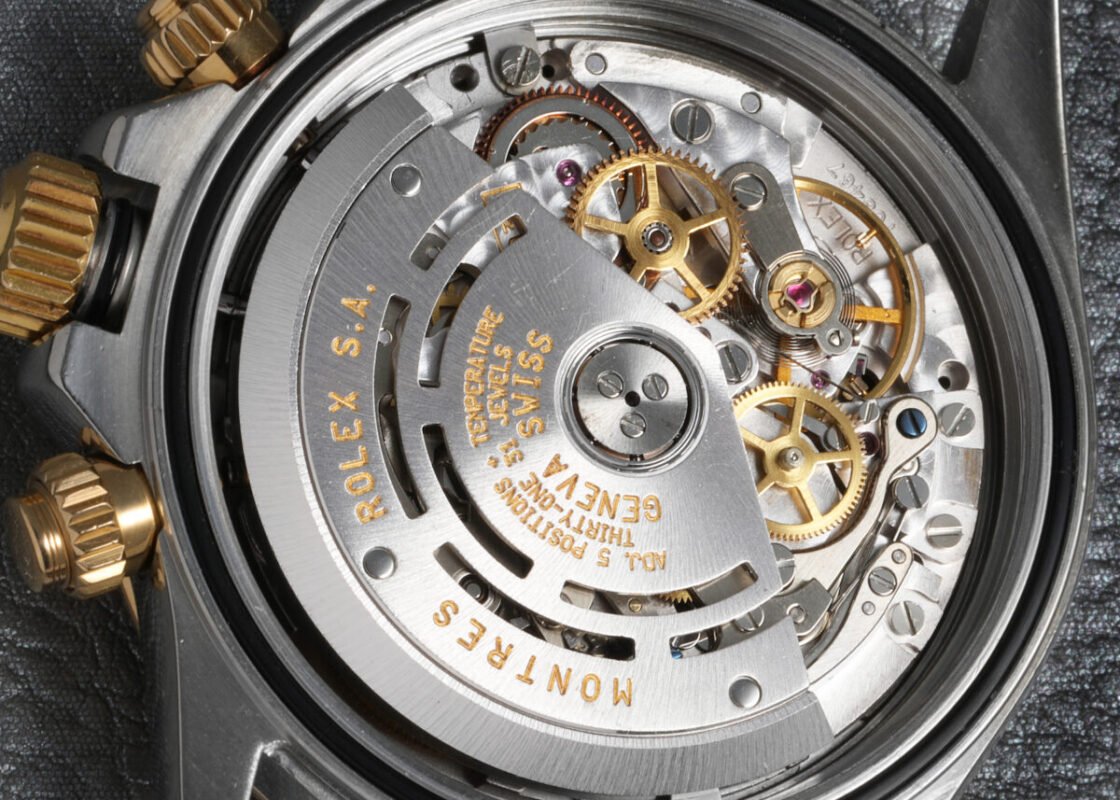
Most watch companies buy a movement, or a base movement, and modify it. Rolex builds its own — oscillator, mainplate, hairspring, the lot — under its own roof. That control is expensive, but it means the company sets its own tolerances instead of inheriting someone else’s, and it can change a component without renegotiating a supply contract.
The result is consistency. Two examples of the same reference, made years apart, should behave the same way on a timing machine. That predictability is the quiet luxury, more than any finish on a bridge nobody will see.
The components doing the work
Strip away the marketing and a mechanical movement is a small set of jobs performed very well:
- Mainspring — stores the energy, wound by hand or by the rotor, and releases it slowly through the train.
- Gear train — carries that energy to the hands, with every pivot checked for alignment so friction stays low.
- Escapement and balance wheel — the heartbeat, releasing energy in measured beats and regulating the rate.
- Perpetual rotor — an oscillating weight that winds the mainspring from wrist movement alone.
- Crown and seals — a sealing system rather than a knob, with multiple gaskets keeping water and dust out.
The hairspring deserves its own line. Rolex’s Parachrom alloy resists magnetism and handles shock better than a traditional steel spring, which matters in a world full of phones, laptops and speaker magnets. Some references use Syloxi, a silicon hairspring, for the same reasons.
Three dates that built the reputation
In 1926 the Oyster case became the first genuinely waterproof watch case, protecting the movement from dust and moisture in a way nobody had managed before. Five years later, in 1931, the Perpetual rotor turned wrist movement into winding energy and made the self-winding watch practical.
Then came the demonstration that still gets cited. In 1960 a purpose-built Rolex, the Deep Sea Special, was fixed to the hull of the Trieste bathyscaphe for its descent into the Mariana Trench. It came back up running. Whatever you think of stunts, that one answered a question buyers cared about.

Accuracy, certification and the two-test system
Most Rolex movements are COSC-certified chronometers, which requires accuracy within -4/+6 seconds a day. Plenty of the brand’s watches beat that figure. The reason is a second round of testing: after casing, each watch is checked again by Rolex to its own Superlative Chronometer standard, which is tighter than the certificate demands.
Two tests matter because a movement that keeps perfect time on a bench can lose it once it is inside a case, attached to a bracelet and worn on a wrist. Testing the assembled watch, not just the calibre, is the part many brands skip.
Why the price sits where it does
Four costs explain the premium, and only one of them is mechanical:
- Testing — accuracy, water resistance and durability checks on every unit.
- Materials — high-grade metals, proprietary alloys such as 904L Oystersteel, and synthetic sapphire crystal.
- In-house production — designing, prototyping and manufacturing under one roof is resource-intensive.
- Prestige — decades of history that buyers are willing to pay for.
The last two are where the money actually goes. Testing and research cost a fortune, and brand value costs even more. A well-built alternative can share the materials and much of the craft while skipping the heritage premium, which is the entire logic behind the superclone category.
Living with one
Watchmakers generally suggest servicing every five to ten years, depending on the model and how hard it is worn. A service means cleaning, lubrication and regulation, and it is the difference between a movement that lasts decades and one that grinds itself down. Many owners take a watch in every five years for a timing check even when nothing seems wrong.
Daily habits matter too. An automatic worn regularly stays wound and stays accurate; one left in a drawer for months will need setting and may drift until it settles. Avoid magnets, avoid knocks, and have the seals checked whenever the case is opened. For the questions that come up most often, see our FAQ, and for model-specific detail browse the blog.
Frequently asked questions
Are all Rolex movements automatic?
The overwhelming majority of current production is self-winding. Historically there were hand-wound pieces and the Oysterquartz, but the modern catalogue is built around automatic calibres.
How often should a Rolex be serviced?
Every five to ten years is the usual guidance, depending on wear. A five-year interval for a timekeeping check is a sensible habit even if the watch is running well.
Can any watchmaker repair a Rolex movement?
Servicing one needs specific tools and training, but Rolex is so widely owned that most competent watchmakers have handled the calibres. Parts availability, not skill, is usually the limiting factor.
Jake Ehrlich
Jake Ehrlich is a renowned Rolex historian, collector, and the Editor & Publisher of Jake's Rolex World, one of the most widely read Rolex publications globally. With a passion that spans decades, Jake has owned and worn over 650 Rolex watches, ranging…
All articles by Jake Ehrlich →