

Blog
Rolex Submariner: The Dive Watch That Defined a Genre

No other watch carries as much borrowed meaning as the Submariner. It arrived in 1953 as equipment for people working underwater, and it ended up as the default choice for anyone who wants one good watch. That journey — from instrument to icon — is the reason it outsells every other reference in the catalogue and the reason so many replicas of it exist.

From 100 metres to the bottom of the ocean
When Rolex launched the model in 1953, deep diving was a young and dangerous pursuit, and the original Submariner was rated to 100 metres, or 330 feet. That was a serious number for the period. Later versions doubled it to 200 metres, then reached 300 metres — 1,000 feet — where the modern line sits today.
The reputation was sealed in 1960, when a specially adapted Rolex rode the Bathyscaphe Trieste down to the deepest point on the planet, in the Mariana Trench. The watch came back working. Whatever else has changed since, that story is why the name still means something to divers who have never worn one.
A design that stopped needing improvement
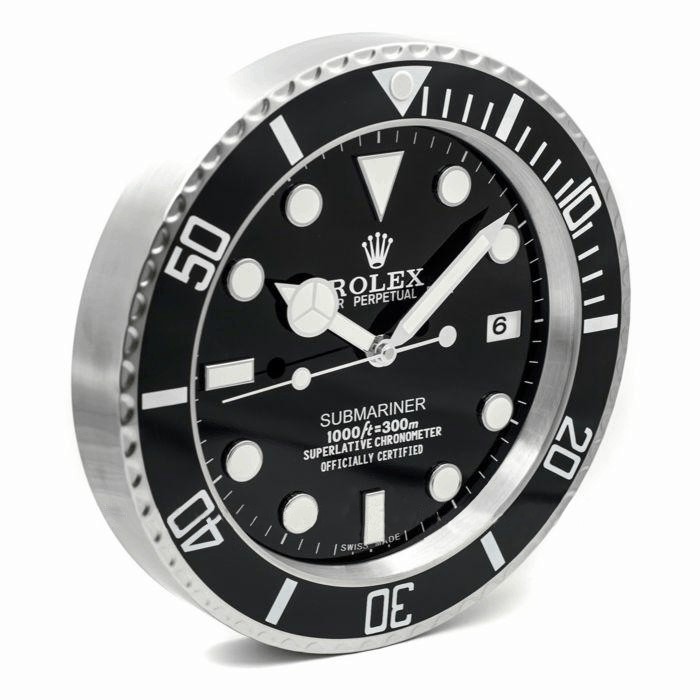
Look at a Submariner from the 1950s beside one from this year and the family resemblance is almost total. The silhouette, the rotating bezel and the large luminous markers have survived with refinement rather than reinvention.
- The bezel turns one way only. A knock against a rock can lose dive time but can never add it, which is the safety logic behind the ratchet.
- The Oyster case is sealed shut. A screw-down back and crown keep water and dust away from the movement, and the same architecture has been in use for decades.
- The bracelet does the work. The Oyster bracelet with its Glidelock clasp allows fine adjustment on the fly, including over a wetsuit.
- Chromalight keeps it readable. Rolex’s lume glows blue for hours, which matters more at depth than any finishing detail.

What is inside the case
Modern Submariners run on in-house calibres, the 3135 or the newer 3235 depending on the reference. Both are known for accuracy and for surviving years of daily wear. The 3235 pushed the power reserve to about 70 hours, which means a watch taken off on Friday evening is still running on Monday morning.
The engineering underneath is unglamorous and effective: paramagnetic components that resist magnetism, a perpetual rotor that winds from wrist movement, and COSC certification for chronometer-grade precision on every movement. Date versions add the instantaneous date change that gives the model its “Date” suffix.
Why it became the first Rolex for so many people
Three things explain the Submariner’s position. The first is range: it works with a wetsuit, a suit and a t-shirt, which no dress watch manages. The second is confidence in the mechanicals — the service interval is five to ten years, and the design has been proven across six decades.
The third is the secondary market. Genuine Submariners hold value unusually well, and many buyers treat the purchase as savings they can wear. Prices start around $8,000 for a steel no-date and climb past $40,000 for gold or rare vintage pieces, so the resale story is not trivial.
Add the cultural weight — Bond, and a long line of celebrities since — and you have a watch that signals competence before it signals money.
Genuine or replica: the honest version
There is no pretending the two are the same object. A genuine Submariner carries decades of provenance, a service network and a serial number that means something. What a good replica offers is the design, the weight and the look, without the five-figure outlay.
People choose one for practical reasons. Some want to test whether a 41 mm diver suits their wrist before committing. Some travel to cities where wearing $15,000 on the arm is a bad idea. Some simply like the object and cannot justify the price. The one thing nobody should do is sell a replica as genuine — that is illegal in most jurisdictions and dishonest everywhere.
What to check before you buy
- Papers and service history on any genuine watch, plus a serial that matches the reference.
- The seller’s record, because a careful dealer inspects every watch and still misses the best fakes.
- The reference itself — case size, bezel material and dial colour all change the value.
- Your own wrist. A 40 mm case wears differently from a 41 mm one, and neither is wrong.
If a genuine watch is out of reach for now, the Submariner category covers the steel, two-tone and gold looks, including the two-tone “Bluesy” that remains our bestseller by a wide margin. Buyers who want a second opinion before ordering can read the customer reviews first.
Frequently asked questions
How much does a Rolex Submariner cost?
Genuine examples run from about $8,000 to over $40,000 depending on reference, year, metal and condition. Steel no-date models sit at the bottom; two-tone, solid gold and rare vintage pieces sit well above that.
Do Submariners need special maintenance?
They need the same care as any mechanical watch: servicing every five to ten years, with gaskets replaced so the water resistance stays intact. Skip it and a dive watch stops being a dive watch.
Can a replica match a genuine Submariner?
At arm’s length, a top-tier super clone can. Under a loupe, next to a real one, differences in finishing and movement appear. Anyone claiming otherwise is selling something.

Jake Ehrlich
Jake Ehrlich is a renowned Rolex historian, collector, and the Editor & Publisher of Jake's Rolex World, one of the most widely read Rolex publications globally. With a passion that spans decades, Jake has owned and worn over 650 Rolex watches, ranging from rare…
All articles by Jake Ehrlich →